
Here's the uncomfortable truth: you don't have a time problem — you have an energy and attention problem. The most productive people on earth don't work more hours. They've simply hacked their systems to work with their brain, not against it.
After diving into the latest neuroscience research, I've distilled the noise into five game-changing productivity hacks that actually work. No fluff. No "just wake up at 5 AM" nonsense. Just proven strategies backed by real science. Let's dive in.
1. The 52-17 Rule: Work in Power Sprints
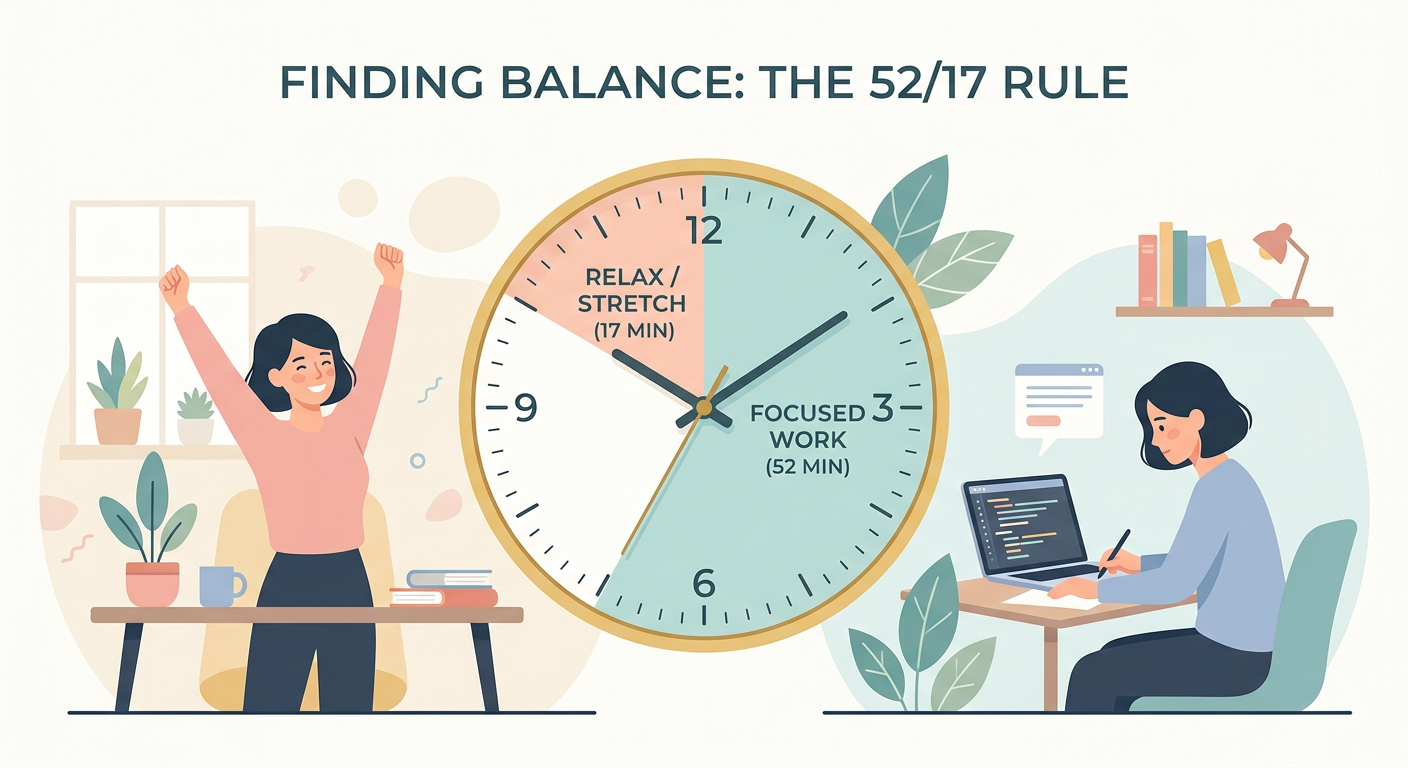
Forget grinding for 8 hours straight. Research by the Draugiem Group tracked the habits of the most productive employees and discovered something surprising: elite performers work in intense 52-minute focused bursts, followed by 17-minute complete breaks.
The magic isn't just the timing — it's the discipline of the break. During those 17 minutes, you must step away from all screens. No scrolling. No "quick emails." Walk, stretch, or simply stare out a window. Your brain needs genuine cognitive recovery to fire on all cylinders.
- Set a timer for 52 minutes of deep, uninterrupted work
- When it rings, STOP — even mid-sentence
- Take a 17-minute screen-free break
- Repeat for 3-4 cycles, then take a longer 30-minute break
The ability to concentrate for sustained periods is a skill that can be trained. But it requires strategic rest to perform at its peak.
2. The Two-Minute Rule: Obliterate Decision Fatigue
Ever notice how tiny tasks pile up and create mental clutter? That's decision fatigue in action — and it's silently destroying your productivity.
David Allen's famous Two-Minute Rule is devastatingly simple: if a task takes less than two minutes, do it NOW. Reply to that email. File that document. Make that call. Don't add it to your list. Don't postpone it. Just execute.
Why does this work? Research shows that the mental energy spent deciding whether to do a task, when to do it, and where to store it often exceeds the energy required to simply complete it. By handling micro-tasks immediately, you free up massive cognitive bandwidth for your most important work.
- Process your inbox using the rule: reply, delegate, archive, or delete
- Handle physical items immediately — file, trash, or action
- Keep a "quick wins" list for tasks under 2 minutes
- Batch similar micro-tasks into dedicated 15-minute windows
3. Time Blocking: Own Your Calendar or It Owns You
If your calendar is just a dumping ground for meetings, you're doing it wrong. Time blocking is the practice of assigning every hour of your day a specific purpose — including deep work, admin tasks, breaks, and even buffer time.
Research from Harvard Business Review shows that employees who time block save an average of 2 hours per day compared to reactive workers. Why? Because they've already decided what to work on, when, and for how long. Zero decision fatigue. Maximum flow state.
- Block your peak energy hours (usually morning) for your most demanding work
- Schedule meetings in batches during your low-energy periods
- Include 15-minute buffers between blocks for unexpected issues
- Protect your deep work blocks like sacred — decline or reschedule conflicts
4. The Evening Brain Dump: Clear Your Mental RAM

A 2018 Baylor University study found that writing a specific to-do list before bed reduced sleep onset time by an average of 9 minutes. But the benefits go far beyond falling asleep faster.
Your brain constantly rehearses unfinished tasks — psychologists call this the Zeigarnik Effect. By dumping everything onto paper before bed, you're telling your brain: "These are captured. You can let go." The result? Better sleep, less anxiety, and a clear head when you wake up.
- Spend 5 minutes writing tomorrow's top 3 priorities
- Capture any lingering tasks or worries — no filtering
- Keep the list physical (paper beats screens before bed)
- Review your list each morning and start immediately with priority #1
5. Single-Tasking: The Multitasking Killer
Here's a stat that should terrify you: multitasking reduces your productivity by up to 40%. Even worse, after each interruption, it takes an average of 23 minutes to fully return to your original task (UC Irvine research). That means 10 quick "just checking my phone" moments could cost you nearly 4 hours of productive work.
Multitasking is a myth. Your brain doesn't work on multiple things simultaneously — it rapidly switches between them, losing precious time and energy at each switch. The solution? Embrace single-tasking with monk-like focus.
- Turn off ALL notifications during deep work sessions
- Use website blockers like Freedom or Cold Turkey
- Put your phone in another room — not just face down
- Practice the "one tab" rule: only one browser tab at a time
Your Daily Productivity Checklist
Print this out. Stick it on your monitor. Make it your daily ritual:
- Night before: Complete your 5-minute brain dump — write tomorrow's top 3 tasks
- Morning: Review your list and time block your day before checking email
- Deep work: Start your first 52-minute sprint on your #1 priority
- Break: Take a genuine 17-minute screen-free break
- Micro-tasks: Apply the two-minute rule throughout the day
- Afternoon: Batch meetings and admin during low-energy hours
- End of day: Process remaining tasks and prep tomorrow's list
Final Thoughts: System Over Willpower
The most productive people don't rely on motivation — they build systems that make success automatic. These five hacks work because they're designed around how your brain actually functions, not how we wish it would.
Start with ONE hack this week. Master it. Then add another. In a month, you'll wonder how you ever worked without them.
You don't rise to the level of your goals. You fall to the level of your systems.
Now it's your turn: which productivity hack are you implementing first? Drop a comment below and let's hold each other accountable!